
Digital Detox Resources
What is a digital fast?
A digital fast is an intentional break from digital devices and media to remove distractions and create space for meaningful, spiritually renewing practices. The goal isn’t just to ditch technology for its own sake, but to turn down the digital noise so that we can reconnect with what matters most.
Before choosing how you will fast, take a prayerful look at your daily digital habits. Try to picture a day in your life at home, at work and during leisure time, and notice where digital devices consume your attention. Write down the apps you use each time you reach for or utilize your device throughout the day, from the time you wake up to when you fall asleep. Here are some categories to consider:
- Social Media
- Messaging & Texting
- Streaming Video
- Online News/Blogs/Podcasts
- Video Games
- Online Shopping
- Work Emails & Productivity
- General Screen Time
- Other Digital Habits
Reflect on the results. Prayerfully consider how these habits affect your soul, relationships and ability to be present. As Jesus said, “For where your treasure is, there your heart will be also.” Our time and attention are a kind of treasure. A digital fast is an opportunity to invest that treasure into what truly matters.
Not everyone will fast in the same way. To choose a digital fast that’s appropriate and challenging for you, start by evaluating your apps and digital activities. Think of your apps in two categories: Utility apps vs. Distraction apps.
- Utility Apps are useful tools that serve a specific purpose in daily life: things like your phone and text for basic communication, calendar and email for work, camera for memories, maps/GPS for directions, banking apps or weather apps.
- Distraction Apps are those deliberately designed to capture and hold your attention: social media feeds, news updates, mobile games, video streaming platforms, shopping services, etc.
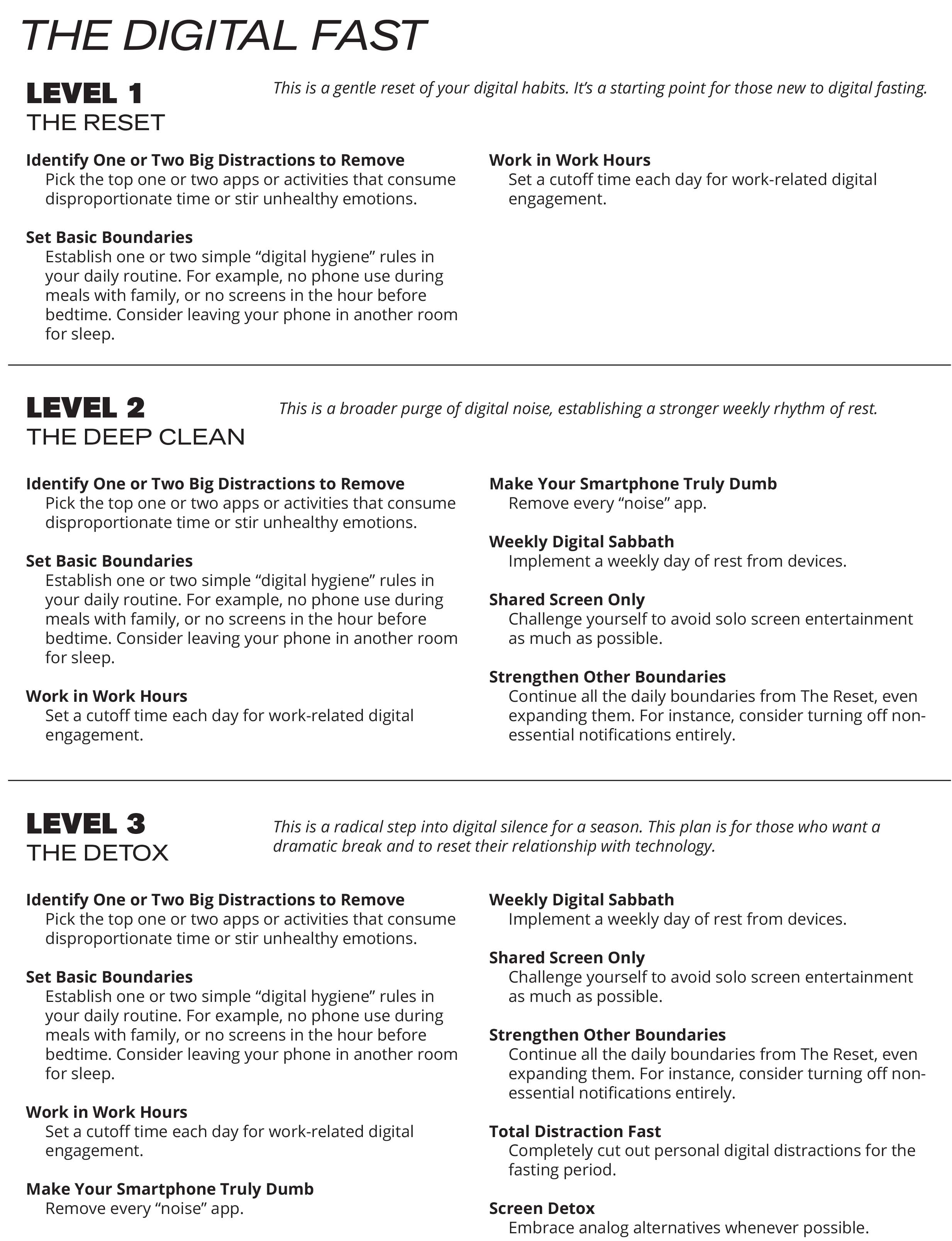
A digital fast can be tailored to different commitment levels. Below are three levels of fasting you can choose from, inspired by Darren Whitehead’s Digital Fast book and teachings (as well as frameworks shared by churches like ours). Each level is a progressive step in detaching from digital distractions. Choose the one that challenges you while still being sustainable in your current season of life.
Each of these fasting levels is designed to help you step back from digital distractions and create space for spiritual renewal.
“Turn my eyes from looking at worthless things; and give me life in Your ways.” – Psalm 119:37
Nursery (6 weeks through 3 years) During the first years of life, children’s brains develop through face-to-face interaction, sensory play and responsive caregiving. Research suggests that children at this age benefit most from face-to-face interaction, play and responsive caregiving.
Articles | Kids & Screen Time: The 5 C’s Questions to Ask for Infants | Kids & Screen Time: 5 C’s Questions for Toddlers & Preschoolers
Podcasts | Healthy Screen Habits Podcast Episodes on raising infants and toddlers without screens | The Mediatrician Podcast (Dr. Michael Rich) Pediatric, research-based insights on early childhood and media
Books | The Mediatrician’s Guide by Michael Rich, MD | Bright from the Start by Jill Stamm, PhD (early brain development, screen-free focus)
Preschool (3-5 years) Preschoolers learn best through play, storytelling and hands-on experiences. Some families choose to include limited, high-quality screen use when paired with adult engagement, while also being mindful of how screens can affect attention and sleep.
Articles | Screen Time and Preschool Children (Pediatrics & Child Health Journal) | Beyond Screen Time: Help Your Kids Build Healthy Media Use Habits
Podcasts | Screen Less Play More Podcast Research-based conversations on reducing screen dependency ScreenTime (KPBS Public Media) Short, expert-led episodes
Books | Parenting Generation Screen by Jonathan McKee | The New Childhood by Jordan Shapiro
Kindergarten-3rd grade As kids begin school, screens often increase through both learning and entertainment. When screens take up a large part of the day, they can unintentionally reduce time for sleep, outdoor play and family connection.
Article | Parenting Children in the Age of Screens Pew Research Center
Podcasts | Screenagers Podcast Screen Sanity Podcast Practical tools for balanced digital habits
Books | The Anxious Generation by Jonathan Haidt | Parenting Generation Screen by Jonathan McKee
4th-5th grade Older elementary students are preparing for adolescence. This season offers a meaningful opportunity to talk about intentional screen use, emotional awareness and values-based decision-making as children grow.
Article | How Screen Time Affects Child Mind Institute
Podcasts | Screenagers Podcast Episodes on gaming, social media and mental health | Screen Less Play More Podcast Managing screens with older kids
Books | The Anxious Generation by Jonathan Haidt | The Amazing Generation by Jonathan Haidt & Catherine Price (kid-friendly companion)
Family Digital Detox Tools (All Ages)
- Family Media Plan – Create shared rules, screen-free zones and tech curfews
- Screen-Free Challenge – Try a weekend or week focused on offline connection
- Modeling Healthy Habits – Kids learn digital balance by watching adults
Podcast | Becoming Something Ep. 167 with Andy Crouch
Book | The Life We’re Looking For: Reclaiming Relationship in a Technological World by Andy Crouch by Andy Crouch
YouTube | Why Social Media is Addictive Washington Post | How Is Your Phone Changing You? ASAPScience
Devotional | Digital Detox by Wendy Speake
Books | The Digital Fast by Dr. Darren Whitehead | Glow Kids: How Screen Addiction Is Hijacking Our Kids and How to Break the Trance by Nikolas Kardaras | Drowning in Screen Time by David Murrow | The Anxious Generation by Jonathan Haidt | The Opt-Out Family: How to Give Your Kids What Technology Can’t by Erin Loechner | Reconnected: How 7 Screen-Free Weeks with Monks and Amish Farmers Helped Me Recover the Lost Art of Being Human by Carlos Whittaker
Podcast | The Anxious Generation
Article | Screens Can Rule Us if We Let Them
Get Resources
For every age group